
1. Introduction
In today's digital era, the demand for fast and high-quality software development is continuously increasing. Traditional methods that rely on manual processes often lead to various obstacles, such as delayed releases, susceptibility to human error, and a lack of workflow efficiency.
Therefore, modern approaches are needed to overcome these barriers. One of the most effective and widely adopted solutions today is Continuous Integration (CI) and Continuous Deployment (CD). These practices are the lifeblood of the DevOps culture, bridging and combining the development process with operations.
2. Core Concepts of CI/CD
a. Continuous Integration (CI)
Continuous Integration is the practice where developers routinely merge their code into a central repository. Every time there is a code change, the system will automatically run tests (automated testing).
Primary Goals of CI:
- Early Detection: Discovering bugs or errors early before they accumulate.
- Conflict Minimization: Reducing the risk of code conflicts between different developers.
- Quality Improvement: Ensuring software standards are maintained.
b. Continuous Deployment (CD)
Continuous Deployment is the advanced stage of CI. In this phase, code that has passed automated testing will be directly deployed to the production environment without requiring any manual intervention.
Main Benefits of CD:
- Lightning-Fast Releases: Accelerating application rollout to users.
- Risk Reduction: Mitigating the potential for errors during the deployment process.
- Agile Updates: Delivering new features and fixes rapidly and continuously.
3. Stages in the CI/CD Pipeline
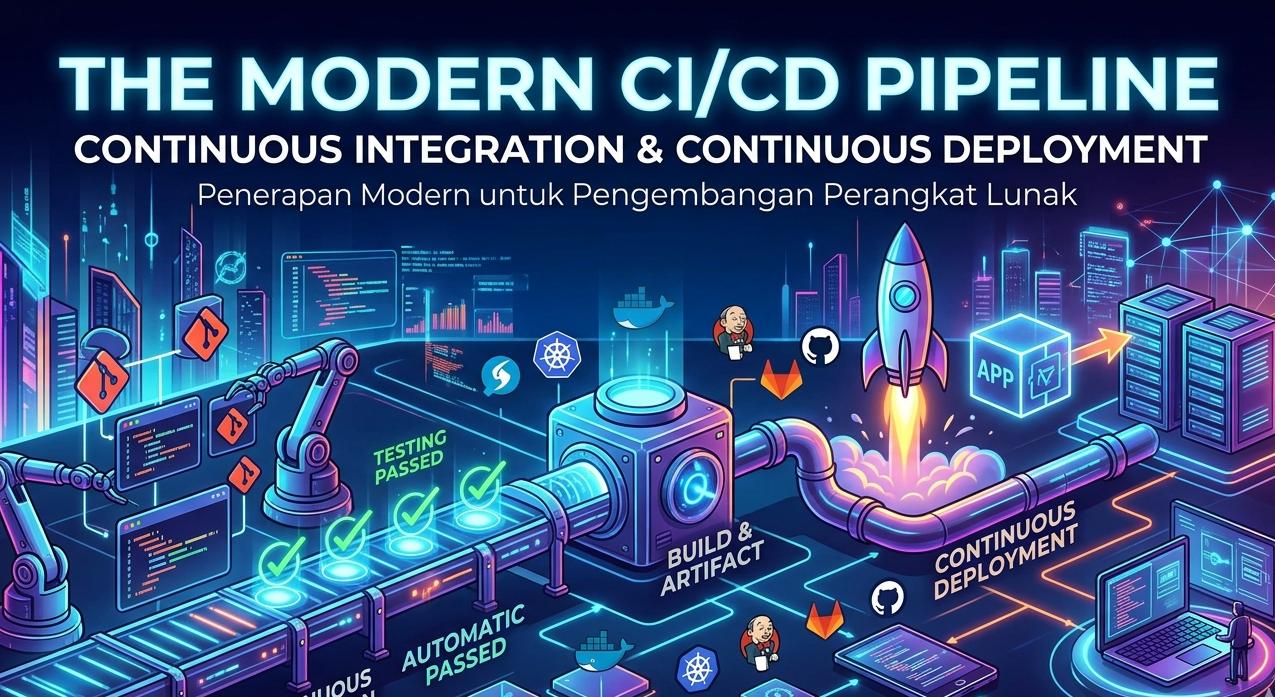
The CI/CD process generally runs on an automated pipeline consisting of several structured phases:
- Code Commit: Developers push the latest code to a version control repository (such as GitHub or GitLab).
- Build Process: The system automatically compiles the code and builds the application so it is ready to run.
- Automated Testing: The system automatically executes testing scripts to validate the code, including:
- Unit Testing
- Integration Testing
- Deployment: Applications that pass testing will be distributed to:
- Staging Server (for final testing/QA).
- Production Server (directly used by end-users).
- Monitoring: Real-time system monitoring to ensure there are no anomalies or errors post-deployment.
4. Popular CI/CD Tools
To implement this pipeline, software engineers typically rely on several industry-standard tools:
- GitHub Actions: Highly flexible for automating workflows directly from GitHub.
- Jenkins: A very powerful and popular open-source CI/CD tool.
- GitLab CI/CD: GitLab's built-in feature that integrates seamlessly with code repositories.
- Docker: The primary solution for application containerization.
- Kubernetes: A reliable orchestrator for large-scale container management.
5. Benefits of CI/CD Implementation
Adopting CI/CD brings significant positive transformations for development teams:
- Exceptional Time Efficiency: Automated build and deployment processes drastically cut wait times.
- Sharply Improved Software Quality: Every changed line of code is constantly validated by the system (automated testing).
- Minimal Human Error: Reduces manual intervention, which is often a source of operational mistakes.
- Super-Fast Feedback Loop: Developers immediately know and can fix code if a failure occurs (build fail).
6. Case Study: E-Commerce Startup
Let's look at the comparison of a startup team developing an e-commerce application, before and after adopting CI/CD:
Before using CI/CD:
- Deployment was done entirely manually by the IT team.
- Frequent downtime or fatal errors during feature updates.
- The release cycle took weeks.
After using CI/CD:
- Every code commit goes directly through automated testing.
- Deployment to the production server runs smoothly in just minutes.
- Bugs are immediately detected in the staging environment before touching users.
Final Results Achieved:
- 🚀 Developer productivity increased sharply.
- 🛍️ Users enjoy updates and feature fixes much faster.
- 🛡️ The system runs much more stably and reliably.
7. Challenges in CI/CD Implementation
Despite offering a myriad of benefits, the transition to CI/CD is not without hurdles:
- Learning Curve: Requires deep technical understanding of fairly complex tools.
- Initial Time Investment: Configuring and building the pipeline (setup) requires dedicated effort and time.
- Cultural Shift: Demands high discipline and a highly collaborative work culture within the team.
However, all these challenges can be overcome over time through intensive training and hands-on experience.
Conclusion
Continuous Integration and Continuous Deployment (CI/CD) are not just buzzwords, but essential solutions for boosting efficiency and quality in software engineering. Through structured automation, teams can produce applications that are stable, agile, and highly responsive to dynamic user needs.
Although it demands adaptation and effort in the initial phase, the long-term Return on Investment (ROI) gained is highly worthwhile, especially to survive and compete in the lightning-fast tech industry.
References
- Humble, J., & Farley, D. (2010). Continuous Delivery: Reliable Software Releases through Build, Test, and Deployment Automation. Addison-Wesley.
- Fowler, M. (2006). Continuous Integration. martinfowler.com
- GitLab Documentation. (2023). CI/CD Pipelines. https://docs.gitlab.com
- Atlassian. (2023). What is CI/CD? https://www.atlassian.com
